




Heat Treatment of Aluminium Die Castings: T5, T6, T7 and the Preconditions
A high-pressure die casting can reach good strength in the as-cast state. For crash-relevant structural parts, however, designers often need more: higher yield strength, more elongation or both. Heat treatment delivers this – but only if the casting, the alloy and the process have been prepared for it. Otherwise the furnace turns hidden gas porosity into visible blisters.
Can Aluminium Die Castings Be Heat Treated?
Yes, but not every part. T5 (artificial ageing after quenching from the die) is possible for many age-hardenable alloys. T6 and T7 include a solution heat treatment at high temperature, where entrapped gas in conventional die castings expands and causes blisters and swelling.
Heat treatment of aluminium die castings with solution treatment therefore requires a low-gas process such as high-vacuum die casting, a clean melt, a heat-treatable alloy with magnesium and a plan for distortion, straightening and testing.
What F, T5, T6 and T7 Mean
For aluminium castings, EN 1706 (current edition DIN EN 1706:2021-10, including Amendment A1) contains its own section on temper designations. Alloy suppliers use the same letters in their data sheets. The tempers relevant for die castings are:
| Temper | Process Route | Typical Aim |
|---|---|---|
| F | As cast, no heat treatment | Standard for most die castings |
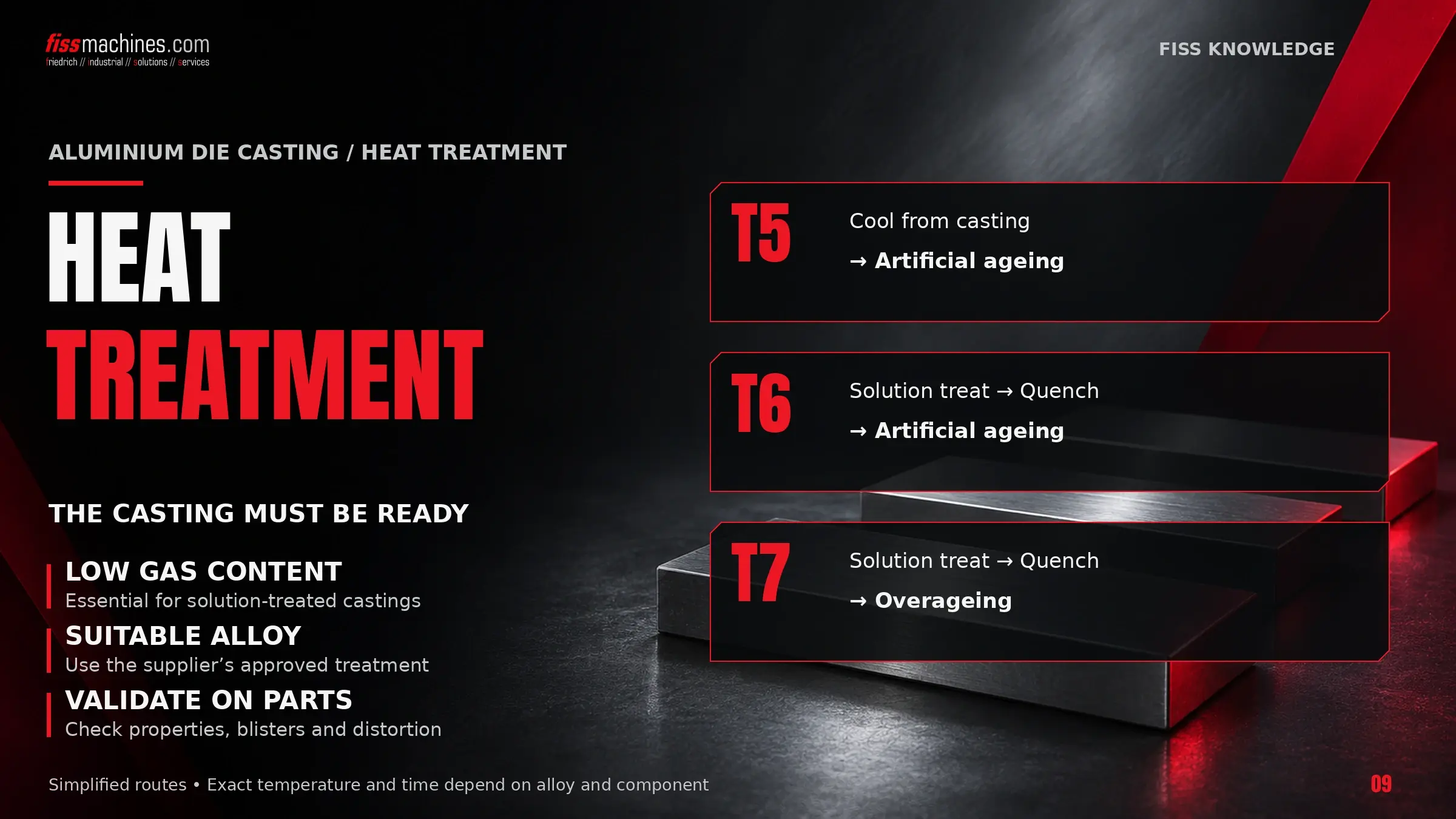
| T5 | Rapid cooling from the casting temperature, then artificial ageing – no solution treatment | Moderate strength increase at low effort |
| T6 | Solution heat treatment, quenching, artificial ageing | High yield strength with good elongation |
| T7 | Solution heat treatment, quenching, overageing | High elongation and energy absorption, stabilised condition |
Supplier data also list T4 (solution treatment and natural ageing), T64 (partial ageing) and O (annealed). The exact definitions are given in the standard; drawings and orders should state alloy, casting process and temper together.
Why Conventional Die Castings Blister During Solution Treatment
During high-pressure die casting, air and process gases can be trapped in the casting within milliseconds. At room temperature these pores are often harmless. At solution treatment temperatures, however, the metal softens while the gas in the pores expands. Near the surface the pore pushes the skin outwards – a blister forms. Lumley et al. (CSIRO) describe exactly this: internal porosity and entrapped gases cause surface blisters, and parts may become dimensionally unstable due to swelling. For this reason, conventional HPDC parts are normally not solution treated at high temperatures.
What Has to Be in Place Before a T6 or T7 Treatment
- Low gas content in the casting: vacuum or high-vacuum die casting, tight dies and a controlled shot profile. The principles are explained in Mold Filling and Vacuum in Die Casting.
- Clean, degassed melt: dissolved hydrogen and oxides add to porosity – see Aluminium Melt Quality.
- Heat-treatable alloy: AlSiMg-type alloys harden through magnesium. For Silafont-36 (AlSi10MnMg), Rheinfelden states an adjustable magnesium content of 0.1 to 0.5 %: more magnesium for strength, less for elongation.
- Design and support: wall thickness, ribbing and furnace fixtures decide how much the part distorts during quenching.
- Qualification: sample parts run through the complete heat treatment cycle before series release.
Material selection in general is covered in Aluminium, Zinc or Magnesium? If heat treatment is mandatory and vacuum HPDC is not an option, gravity die casting may be the better process – see the comparison of gravity and high-pressure die casting.
From Casting to Aged Part: The Sequence
The following example values come from the Rheinfelden Alloys processing data sheet for Silafont-36. They are manufacturer recommendations for the standard process, apply without heating-up time and may be varied, for example to minimise distortion.
Casting and Removal
For T5: quench in water immediately after removal from the die, at as high a temperature as possible, then age as for T6.
Solution Heat Treatment
Example from the source: 480–490 °C for 2–3 hours; for special parts a reduction to 400 °C for 0.5 hours is stated as possible.
Quenching
In water at 10–60 °C without delay wherever possible. According to the source, air cooling gives a significantly lower yield strength.
Interim Storage and Straightening
A delay before artificial ageing only if straightening is required, usually a maximum of 12 hours.
Artificial Ageing or Overageing
Example from the source: T6 at 155–170 °C for 2–3 hours; T7 (overageing) at 190–230 °C for 2–3 hours.
Water or Air? The Trade-Off Between Strength and Distortion
Fast quenching keeps the alloying elements in solution and is the basis for high strength after ageing. At the same time, a water quench creates steep temperature differences in thin-walled, large structural parts – the typical cause of distortion. Distorted parts must be straightened. The data sheet provides for this step between quenching and ageing and limits the interim storage time accordingly.
Maximum Strength
Highest yield strength after ageing, but higher risk of distortion and more straightening work on large, thin-walled parts.
Less Distortion
Lower cooling rate and less distortion. Alloys such as Silafont-38 were developed to reach high yield strength even with air quenching.
What Heat Treatment Achieves – Manufacturer Data
Rheinfelden Alloys publishes the following ranges for high-pressure die cast Silafont-36. They are manufacturer statements, not guaranteed values; actual properties depend on part, process and test location.
| Temper | Yield Strength Rp0.2 [MPa] | Tensile Strength Rm [MPa] | Elongation A [%] |
|---|---|---|---|
| F | 120–150 | 250–290 | 5–11 |
| T5 | 155–245 | 275–340 | 4–9 |
| T6 | 210–280 | 290–340 | 7–12 |
| T7 | 120–170 | 200–240 | 15–20 |
The pattern is clear: T6 raises strength, T7 trades strength for elongation. For Silafont-38, the manufacturer states 230–270 MPa yield strength after T6 with water quench and 180–200 MPa with air quench. Non-heat-treatable alternatives also exist: according to Rheinfelden, Castasil-37 (AlSi9MnMoZr) reaches high elongation in the as-cast state, avoiding blisters and distortion from solution treatment; TRIMET describes trimal-37 (AlSi9Mn) as a heat-treatment-free alloy for ductile die castings.
Furnaces, Quench Systems and Quality Checks
Continuous Furnace Lines
Roller hearth or chain conveyor furnaces for solution treatment with integrated water or air quench – suited to high volumes of structural parts.
Chamber Furnaces
Forced convection chamber furnaces for solution treatment of smaller batches, combined with a separate quench tank.
Ageing Ovens
Air circulation ovens for artificial ageing and overageing at lower temperatures; also used alone for T5.
Temperature uniformity, short transfer times between furnace and quench, and baskets or fixtures that support the parts matter more than nominal capacity. EN 1706 contains requirements for tensile tests, test pieces taken from castings and hardness tests. In practice, the following checks are typical:
- Tensile tests on test pieces taken from defined locations of the casting
- Hardness tests as a quick check of the ageing result per batch
- Visual blister inspection after solution treatment, especially on sample parts
- Dimensional check after quenching and straightening
- Furnace temperature records per batch
Heat Treatment Starts at the Die Casting Machine
T5 is a low-risk option for many die castings. T6 and T7 deliver the properties needed for structural parts, but only if the casting is made with low gas content, the melt is clean and the alloy is designed for it. Anyone planning heat-treated die castings should consider die casting cell, vacuum system, furnaces and testing as one process chain – and check whether a non-heat-treatable alloy can meet the requirements as cast.
Questions About Heat Treating Die Castings
What Is the Difference Between T5 and T6?
T5 means artificial ageing after cooling from the casting temperature without solution treatment. T6 adds a solution heat treatment and quench before ageing and therefore achieves higher strength – but requires a low-gas casting.
Why Do Die Castings Blister in the Furnace?
Entrapped air and process gases expand at solution treatment temperature while the metal softens. Pores close to the surface push the skin outwards and form blisters.
Is Vacuum Die Casting Mandatory for T6?
For solution-treated parts, a low gas content is the key precondition. In practice this is usually achieved with vacuum or high-vacuum die casting combined with good melt quality; sample parts should confirm it.
When Is T7 Used Instead of T6?
When elongation and energy absorption matter more than maximum strength, for example in crash-relevant structural parts. Overageing lowers strength but raises elongation.
Used Furnaces and Foundry Equipment from FISS.
From melting and holding furnaces to complete casting cells: FISS lists used furnaces and die casting equipment and helps you find machines that suit your process.
Sources
DIN EN 1706:2021-10 – Aluminium and aluminium alloys – Castings – Chemical composition and mechanical properties (includes Amendment A1:2021); table of contents, din.de, accessed 5 November 2026.
RHEINFELDEN ALLOYS: Silafont-36 [AlSi10MnMg] – Sequence of work when producing high pressure die castings, processing data sheet, version 8 – 06/2015.
RHEINFELDEN ALLOYS: Silafont and Castasil alloy pages and feature sheets Silafont-36 and Castasil-37 (version 2016-01), rheinfelden-alloys.eu, accessed 5 November 2026.
RHEINFELDEN ALLOYS: Silafont-38 [AlSi9MnMgZn], alloy handbook chapter, 2015.
R. N. Lumley et al.: The role of alloy composition in the heat treatment of aluminium high pressure die castings, Metallurgical Science and Technology 26 (2008), No. 2.
TRIMET: product page trimal-37, trimet.eu, accessed 5 November 2026.
Nabertherm: Artificial Ageing, Tempering, Quenching, Annealing and Hardening, nabertherm.com, accessed 5 November 2026.
