




Forging Presses Explained: Hydraulic, Mechanical and Screw Presses Compared
A forging press shapes heated metal between dies – but not every press does this the same way. Whether the machine is limited by force, by stroke or by energy determines how long the die touches the hot part, how hot the die gets and which parts can be forged economically.
What Is a Forging Press?
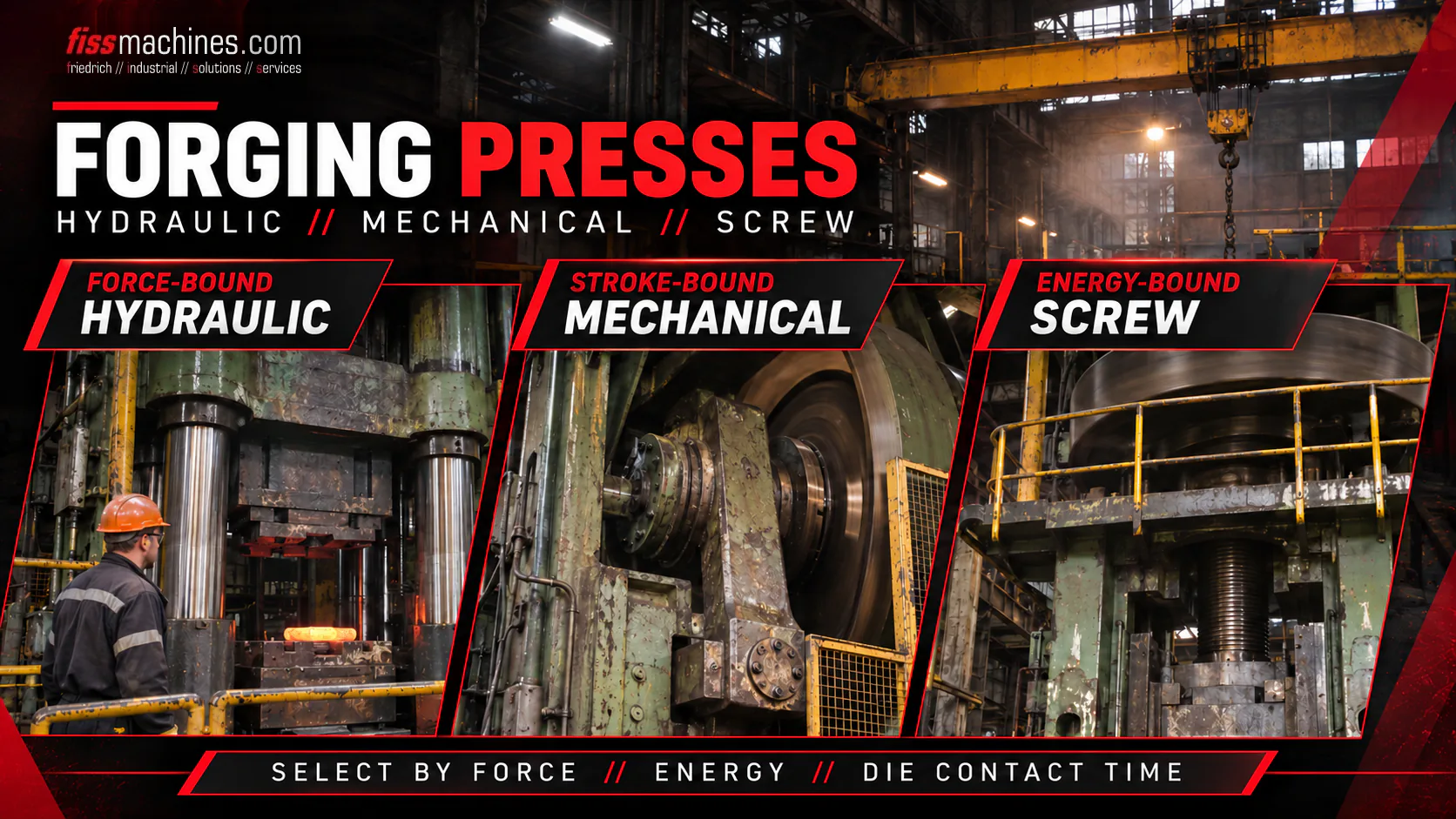
A forging press is a forming machine that plastically deforms a heated (or, in cold forging, unheated) workpiece between two dies by squeezing it. Forging presses are grouped by what limits their work: hydraulic presses are force-bound, mechanical crank, eccentric and wedge presses are stroke-bound, and screw presses – like hammers – are energy-bound.
For the forging shop, this classification decides ram speed, die contact time, overload behaviour and the reaction to a billet that is too cold.
Force-Bound, Stroke-Bound, Energy-Bound: The Forging View
Forging literature, for example Altan and Shirgaokar in the ASM Handbook, classifies forging machines by the quantity that limits their forming capability. Ram speeds are typical textbook ranges, not values of a specific machine.
| Machine Type | Limited By | Typical Ram Speed | Forging Behaviour |
|---|---|---|---|
| Hydraulic forging press | Maximum force | approx. 0.06–0.30 m/s | Full force at any stroke position, long contact time |
| Mechanical crank, eccentric or wedge press | Stroke and force curve | approx. 0.06–1.5 m/s | Fixed bottom dead centre, high stroke rates |
| Screw press | Flywheel energy | approx. 0.6–1.2 m/s | Ram stops when energy is used up, short contact time |
| Hammer (comparison) | Ram energy | approx. 3–9 m/s | Impact loading, very short contact time |
General drive differences are not repeated here; the focus is on dies, materials and parts.
Hydraulic Forging Presses: Force on Demand
A hydraulic forging press can apply its rated force at any position of the stroke and hold it. This makes the hydraulic forging press the standard for open-die forging of large shafts and rings and for large closed-die parts that need very high forces. SMS group, for example, states hydraulic closed-die forging presses with forces between 10 and 1,000 MN and controllable press speeds of 0.01 to 100 mm/s (manufacturer statement, website accessed November 2026).
The limitation is speed: the slow ram keeps the hot part in contact with the die for a long time, so the part cools and the die heats up. For aluminium alloys, forged with heated dies, slow deformation can be an advantage.
Mechanical Forging Presses: Crank, Eccentric and Wedge
In a mechanical forging press, a crank or eccentric shaft converts the rotation of a flywheel into a ram movement with a fixed bottom dead centre; the highest force is only available shortly before it. A billet that is too cold or too large can make the press stall in the die, which overload protection has to handle.
Productivity in Series Forging
High stroke rates and a defined end position make them the workhorses of automated closed-die lines.
Stiffness Against Tilting
SMS group describes its KP wedge presses as suited to long parts with close thickness tolerances and minimal ram tilting (manufacturer statement).
Programmable Slide Motion
Schuler states for its servo eccentric presses (MSE) minimal pressure contact times and longer idle times for die cooling (manufacturer brochure).
Screw Presses: Energy-Bound Forging Machines
A screw press accelerates a flywheel and converts its rotation via a steep-thread screw into a ram stroke. The ram stops when the stored energy is consumed; there is no fixed bottom dead centre. If the dies have not closed, a further blow follows.
- Friction drive: the classic design – simple, with wear on the friction lining.
- Direct electric drive: the motor drives the screw without gears; Schuler states adjustable forging energy of 5–100 % (manufacturer brochure).
- Clutch-operated screw press: a rotating flywheel is coupled to the screw for each stroke, e.g. SMS SPKA series (manufacturer statement).
LASCO describes its direct-driven screw presses as suited to precision forging of steel, high-alloy and non-ferrous materials, with nominal forces of 2 to 50 MN (manufacturer brochure, 12/2021). Hammers remain the alternative for very short contact times and several blows per part.
Open-Die or Closed-Die Forging: What the Press Must Deliver
Simple Tools, Large Parts
Step-by-step shaping between flat or simple dies. Typical for shafts, rings and one-off parts on hydraulic presses or hammers.
Shape in the Die Cavity
The metal fills a die cavity, usually with flash. Typical for series parts such as con rods and gears on mechanical presses, screw presses or hammers.
Trimming the flash is a separate step on a trimming press. FISS lists used trimming presses.
Die Contact Time, Die Temperature and Material
Die contact time under pressure is why the press type matters in forging. Uddeholm notes that press forging involves much longer contact time than hammer forging, making heat resistance of the die steel more important than impact toughness. Prolonged contact accelerates wear and heat checking; hammer dies tend to fail more by cracking.
| Material | Typical Hot Forging Temperature | Forging Note |
|---|---|---|
| Steel | 1,050–1,250 °C | Contact time strongly affects die wear |
| Aluminium alloys | 350–500 °C | Narrow window, heated dies |
| Warm forging (steel) | 550–950 °C | Higher accuracy, mostly mechanical presses |
Forging or Casting? A Short Decision Aid
Forging closes internal porosity and creates a grain flow following the part contour, which benefits fatigue strength. Casting allows complex shapes, cavities and thin walls. The choice between casting processes is covered in Gravity Die Casting or High-Pressure Die Casting?
- Fatigue-critical or safety part with a compact shape: usually forging
- Complex geometry, cores, thin walls: usually casting
- Pressure-tight part: casting needs porosity control, forging adds machining
- Large series: closed-die forging or die casting
Sourcing a Used Forging Press: What to Check
A used forging press has worked under shock and thermal loads, so its history matters more than its age. Assess automation too: transfer, induction heating, die spraying and handling decide output as much as the press.
- Principle and size: force, energy or stroke, die space, shut height
- Frame and guides: cracks, guide play, screw and nut on screw presses
- Drive: clutch, brake, overload protection, flywheel bearings
- Hydraulics: leaks, pumps, valves, fluid condition
- Control: generation, spare parts, records of overloads and repairs
- Safety: guarding and CE status, checked with a qualified expert
Overhaul and control retrofit options are explained in Overhaul or Retrofit? FISS lists used hydraulic presses and mechanical presses in its presses overview; a specific forging press is best sourced through a targeted search.
The Forging Press Must Match Part, Material and Die
Hydraulic forging presses offer force on demand, mechanical presses productivity in automated series forging, and screw presses dosed energy with short contact times. Choosing a forging press means weighing contact time, material and automation – and, for a used machine, its load history.
Questions About Forging Presses
Why Is a Screw Press Called Energy-Bound?
A screw press can only do as much work per blow as the energy stored in its flywheel. The ram stops when this energy is used up, so there is no fixed bottom dead centre.
Which Forging Press Is Used for Aluminium?
Aluminium alloys are forged in a narrow temperature window with heated dies. Hydraulic presses and screw presses are common, and mechanical presses are also used for series parts.
How Does Die Contact Time Affect Die Life?
The longer the hot part stays in the die under pressure, the hotter the die surface becomes. This accelerates wear and increases the risk of heat checking. Shorter contact, proper die preheating and suitable lubrication help to extend die life.
Does FISS Sell Used Forging Presses?
FISS lists used hydraulic and mechanical presses in its presses overview. A specific forging press can be sourced through the FISS machine search service, which looks for suitable machines on the market.
FISS Searches the Market for You.
Describe the part, material and required force or energy. FISS looks for a suitable used forging press and supports dismantling, transport and commissioning.
Sources
T. Altan, M. Shirgaokar: Selection of Forging Equipment, ASM Handbook Vol. 14A, Metalworking: Bulk Forming, ASM International, 2005 (abstract; classification of forging machines).
Dayalbagh Educational Institute, Virtual Labs: MEM-103 Manufacturing Processes-I, Unit 3, Forging Equipment – ram speeds and machine classification, accessed 6 November 2026.
Uddeholm: Uddeholm Tool Steels for Forging Applications, edition 4, 10.2017 – contact time, die failure, typical forging temperatures.
Schuler: Screw Presses with Direct Drive and Servo Eccentric Press MSE brochures; The Entire World of Forging at a Glance, 10/2022, accessed 6 November 2026.
LASCO Umformtechnik: Screw Presses – Precision for Solid Forming, version 3.0, 12/2021, accessed 6 November 2026.
SMS group: Closed-die forging presses (eccentric, wedge, screw and hydraulic presses), sms-group.com, accessed 6 November 2026.
Forging Industry Association: Product Design Guide for Forging – grain flow and directional properties.
