




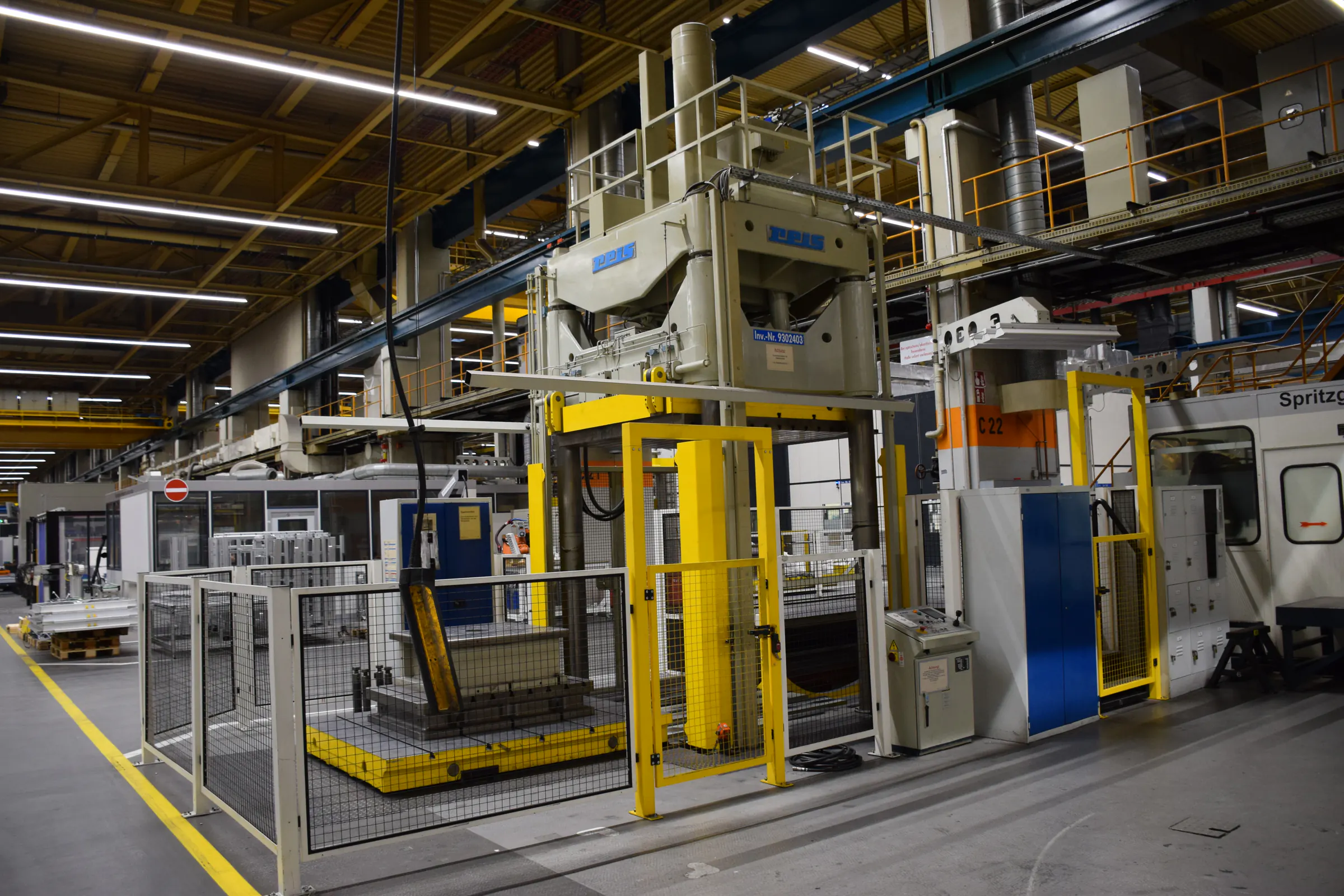
Die Spotting Presses: How Try-Out Presses Work and What Buyers Should Check
Even precisely machined die components rarely fit perfectly at the first attempt: shut-off faces, parting lines and forming surfaces have to be matched by hand. A die spotting press is built for this work – it closes the die slowly and precisely, opens it for access to both halves and keeps the production machine free.
What Is a Die Spotting Press?
A die spotting press is a usually hydraulic press used in the tool shop to close the two halves of a die under controlled force and at very low speed, so that the contact pattern left by spotting ink can be checked and corrected. Typical features are a tilting or turnover upper platen, moving bolsters, a sensitive spotting mode and parallelism control.
A try-out press goes one step further: it also runs the die under conditions close to the later production press – for example with programmable slide motion and a drawing cushion.
Design and Operating Principle of a Die Spotting Press
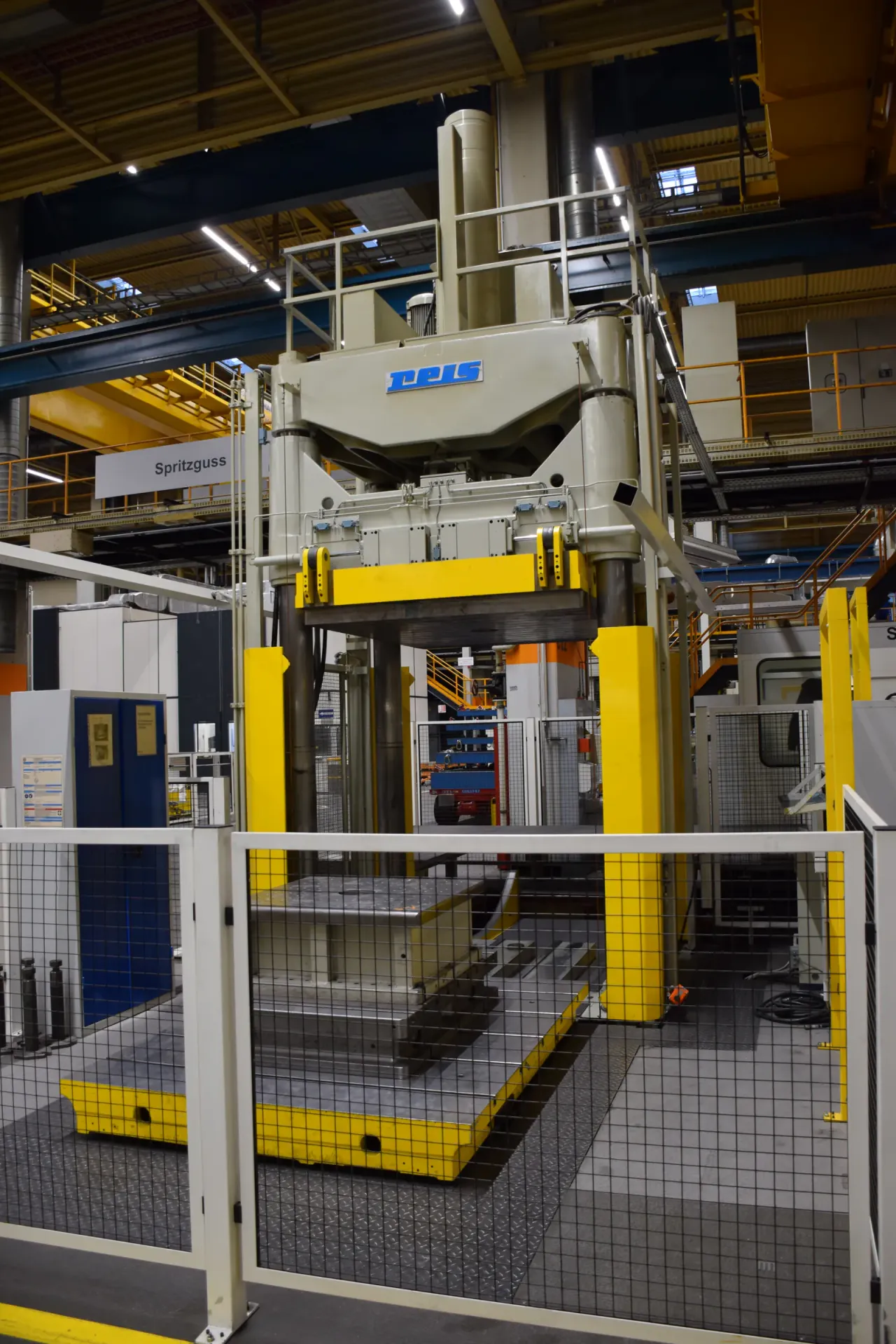
Most die spotting presses are hydraulic presses of four-column or frame design. Unlike a production press they are not built for stroke rate but for slow, precisely controlled closing and access to both die halves.
| Assembly | Function | What matters |
|---|---|---|
| Press frame | Four-column or frame structure absorbs the press force | Stiffness, column spacing and clearance for die attachments |
| Ram / upper platen | Carries the upper die, tilting or turnover depending on design | Clamping system, load capacity, tilt angle |
| Lower bolster / moving bolster | Carries the lower die and moves it out of the press for rework and loading | Travel, load capacity, positioning accuracy, crane access |
| Hydraulics | Power unit, cylinders and valves for rapid traverse, spotting mode and press force | Sensitive control at very low speeds, tightness |
| Parallelism control and position measurement | Keeps upper platen and bolster parallel and reports the position | Measuring system, control quality under off-centre load |
| Control and safety system | Control desk, operating modes, ram lock, safety fencing and doors | Control generation, spare parts, state of safety functions |
Sequence of a Spotting Cycle
Load the Die
The crane places the die on the extended moving bolster, the bolster moves into the press and the upper die is clamped to the ram.
Apply Spotting Ink
A thin layer of spotting ink is applied to one die half.
Close Slowly
In spotting mode the press closes at very low speed with a defined force.
Open and Provide Access
The press opens, the upper platen tilts or the bolster moves out so that both halves are easy to reach.
Read the Pattern and Rework
The toolmaker assesses the contact pattern and reworks the bearing areas.
Repeat
The steps are repeated until the contact pattern is even.
What Happens During Die Spotting
In die spotting, a thin layer of spotting ink – often a blue paste – is applied to one die half. The die is closed and opened again; where the surfaces touch, the colour transfers. The resulting contact pattern shows where the halves bear and where gaps remain. The toolmaker then reworks the high spots by grinding or stoning and repeats the cycle until the pattern is even.
The method is used for sheet metal stamping and drawing dies as well as for injection moulds and die casting dies, where tight shut-off faces prevent flash. How a die casting die is built is described in Die Casting Die Components.
Use in Tool and Mould Making
Drawing and Cutting Dies
Contact pattern on draw surfaces and blank holders, fitting of cutting edges and guides – often on large presses with die cushions.
Injection Moulds
Tight parting and shut-off surfaces prevent flash; slides and ejectors are checked for function.
Die Casting Dies
Low-flash parting line, core pulls and die inserts after repairs, for example after heat checking – see Die Life in Die Casting.
Spotting Press, Try-Out Press and Production Press
A die can also be spotted in the production machine, but this is slow, ergonomically poor and blocks capacity. In a 2021 trade article, a German mould maker explained that spotting on one of its large injection moulding machines would take considerably longer at more than double the hourly rate – an example of why tool shops invest in dedicated presses.
Fitting the Die
Slow, sensitive closing, opening of the upper platen and good access. Used to match die halves and rework surfaces.
Testing Under Production Conditions
Adds production-like functions such as programmable slide motion, drawing cushions and higher forming speeds for test parts.
Making Parts
Designed for output and cycle time. Poor access to the die and high machine-hour costs make it unsuitable for lengthy rework.
Typical Features of a Die Spotting Press
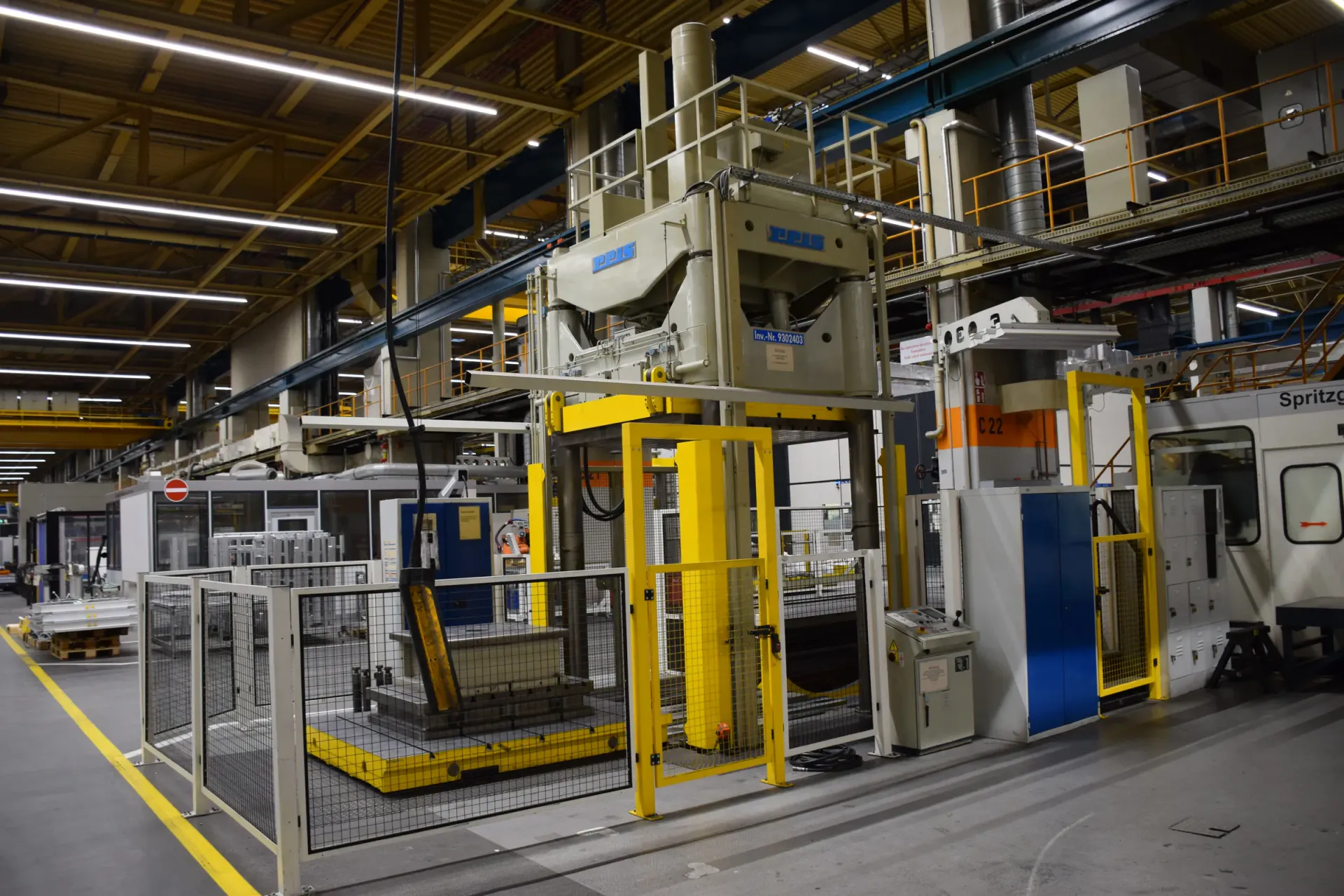
Equipment varies between manufacturers and sizes. The following features are described in manufacturer documentation.
| Feature | Purpose | Manufacturer Examples |
|---|---|---|
| Spotting mode / inching | Very slow, finely controlled closing and opening for the ink transfer | Schuler: separate hydraulic circuit in the “die spotting” mode, slide control via joystick |
| Tilting or turnover upper platen | Brings the upper die half into a comfortable working position | Millutensil: upper table swings out by up to 180° (stepless, depending on model) |
| Moving bolster | Moves the lower die out of the press for rework and crane loading | Schuler: moving bolster to the front as standard; Millutensil: lower tables that travel completely out of the press |
| Parallelism control | Keeps the upper platen parallel to the lower one under off-centre loads | Four cylinders or electronic measuring systems that monitor platen position |
| Slide locking and fall protection | Secures the slide or upper platen during work in the die space | Schuler: mechanical slide locking over the entire stroke; Millutensil: hydro-mechanical fall protection |
| Stroke limitation | Defined closing depth for dies without fixed stops | Schuler: mechanical stroke limitation recommended for narrow depth tolerances |
For die casting dies, column spacing is a practical point: Millutensil states that a wider column spacing avoids having to dismantle large auxiliary cylinders on the die before spotting.
Try-Out Presses: Simulating the Production Press
A die that fits perfectly in a rigid spotting press can still behave differently in production. Ram, bolster and cushion deform elastically under load, and this affects how the die closes. Research at TU Munich is therefore working on compensating press elasticity virtually, based on measurements taken on a try-out press.
Try-out presses for stamping dies address this with production-like functions. According to Schuler, its hydraulic multicurve try-out presses can reproduce the slide motion of mechanical and servo-mechanical production presses, simulate multi-point drawing cushions and reach drawing speeds of up to 500 mm/s via an accumulator drive. An active parallelism control can adapt the slide tilt to that of a mechanical production press. These are manufacturer statements; simple spotting presses usually lack such functions.
What Is Checked During Die Tryout
- Contact pattern of parting, sealing and forming surfaces
- Function of slides, core pulls and ejectors, if the press provides the required connections
- Guides, centring elements and shut height of the die
- Media connections, temperature control and hydraulic circuits for leaks
- On try-out presses: sample parts with production-like ram motion and die cushion force
- Documentation of corrections for later repairs and maintenance
Sizing Press Force, Bolster Area and Accessibility
The right spotting press follows from the range of dies expected in the coming years – not from the production press. The best starting point is a list of the largest, heaviest and tallest dies with their attachments.
| Parameter | Meaning | How to determine |
|---|---|---|
| Press force | Force to close the die safely and produce a meaningful contact pattern | Based on die size and the manufacturer's recommendation; reserve only if try-out functions are used |
| Bolster area | Usable area of upper platen and bolster | Largest die footprint plus clamping margin and attachments; T-slots or hole pattern matching the clamping system |
| Daylight and stroke | Clear distance between the platens | Tallest die plus opening stroke and clearance for tilting |
| Load capacity | Permissible weight on ram, tilting unit and moving bolster | Heaviest upper and lower die, checked against manufacturer data |
| Column spacing and clearance | Space between the columns for die attachments | Consider core pull cylinders, slides, hoses and side access |
| Moving bolster and accessibility | How well both halves can be reached | Travel to the front or rear, crane access, working height, lighting and platforms |
A press that is too small blocks the largest dies; one that is far too large costs floor space, foundation and energy. The basic differences between hydraulic and mechanical presses are explained in Mechanical or Hydraulic Press?
What Buyers Should Check
- Platen size and column spacing: largest die plus space for auxiliary cylinders, slides and hoses
- Force: sufficient for spotting the largest dies – a spotting press rarely needs the force of the production press
- Daylight and stroke: maximum distance between the tables for the highest die plus tilting clearance
- Tilt angle and load capacity: maximum swing angle and permitted weight of the upper die half on the tilting platen
- Bolster: travel, load capacity, drive and whether it leaves the press completely for crane access
- Accuracy: parallelism system, measuring method and the manufacturer’s tolerance data – ideally checked with a measurement on site
- Control: type and age, availability of spare parts, recipe storage for die-specific speeds
- Installation: foundation or pit (some designs are underfloor versions), crane hook height and hydraulic power unit position
On used machines, a test run under load shows spotting mode, leaks and parallelism. For dismantling and transport, see Relocating Die Casting Machines.
Safety and Maintenance in Operation
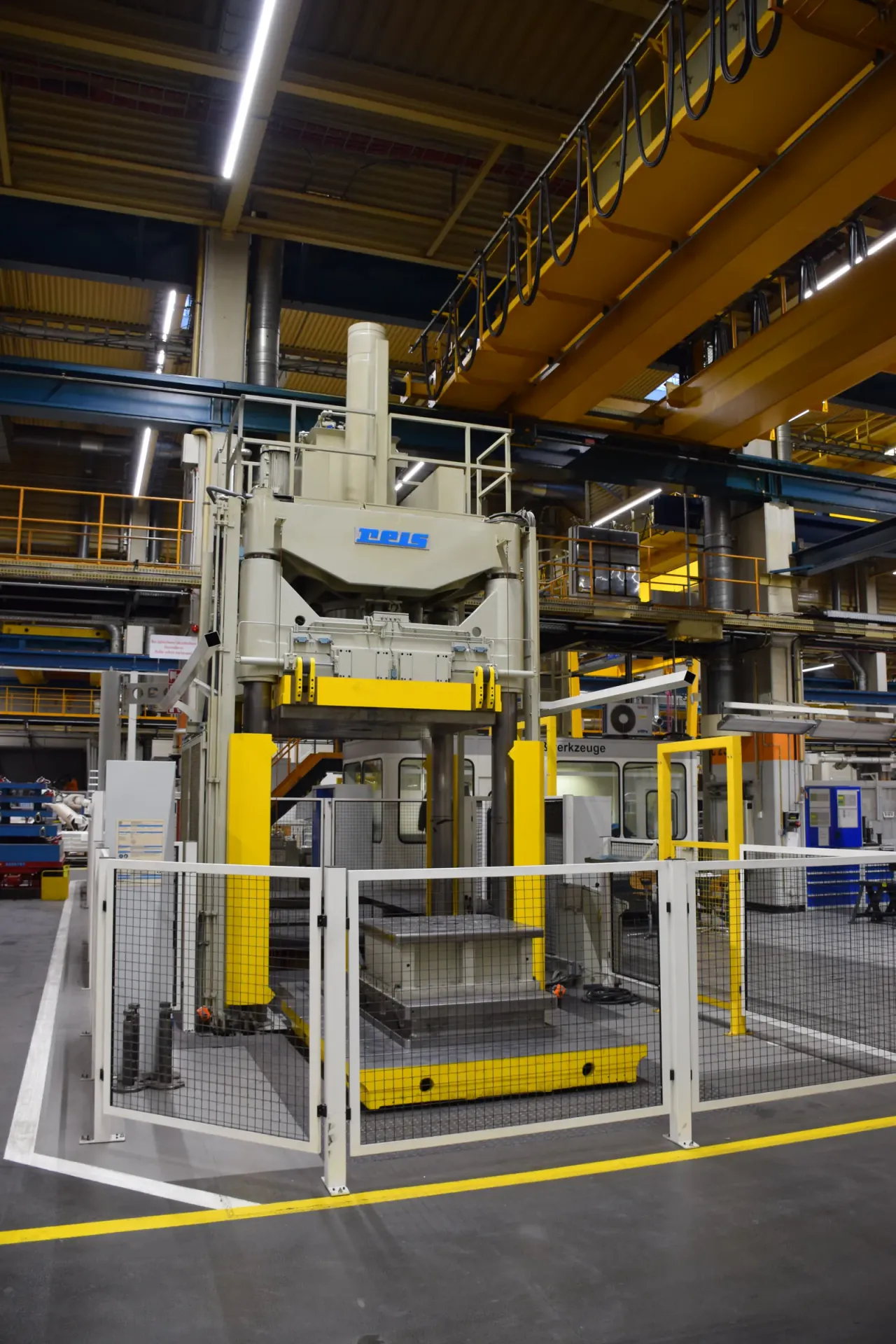
On a die spotting press people regularly work between open die halves. Safety functions and their condition are therefore more important than on many automated presses.
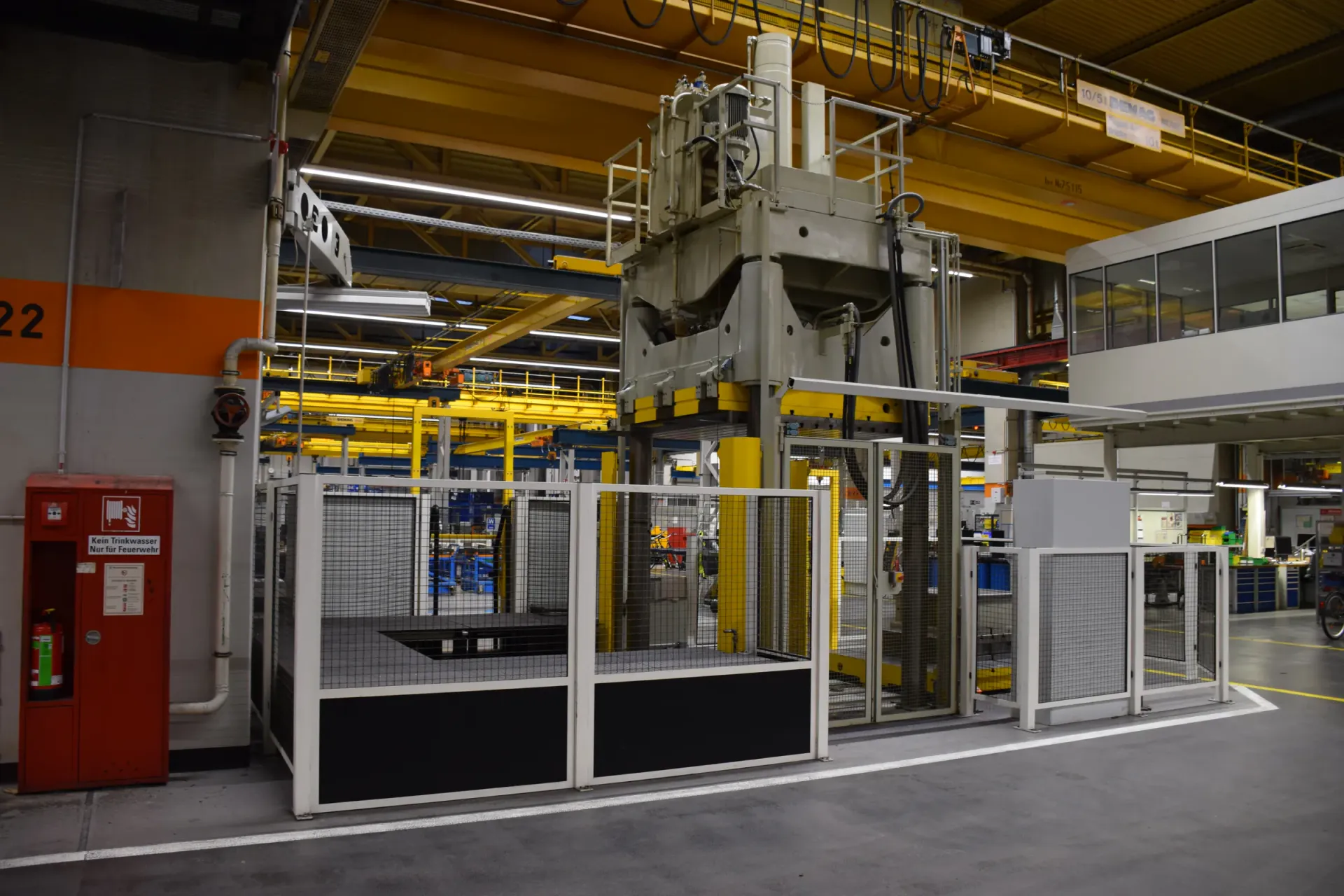
Controlling Hazard Points
Ram lock or fall protection before every intervention between the die halves; safety fencing with interlocked doors and a safeguarded bolster area; crushing points when tilting and moving; operating modes with reduced speed; safe lifting gear for the crane. Safety functions must be inspected periodically by a competent person (in Germany under the Ordinance on Industrial Safety and Health, BetrSichV).
Preserving Accuracy
Monitor hydraulic oil, filters and oil temperature; check leaks and hose lines; lubricate columns and guides; inspect wheels, rails and drive of the moving bolster; maintain clamping elements; measure parallelism and position measuring systems at fixed intervals; back up control data.
Older controls are a typical cause of downtime; see Electronic Spare Parts for Older Foundry Machines. For hydraulics in general, see Hydraulics of Die Casting Machines.
Used or New Spotting Press – and Safety
Proven Machine, Lower Investment
Often quickly available. Check hydraulics, guides and safety equipment; plan for a possible control retrofit.
Current Technology and Safety
Configured to the die range, with current controls and documentation – at higher cost and with a delivery time.
FISS lists both used spotting presses and new spotting presses. The new spotting and try-out presses are offered via a partner, with closing forces of 68 to 600 t, a maximum distance between the two tables of 1,150 to 3,200 mm and a Siemens S7 control. As an example from practice, FISS reported the sale of a used REIS TUS 180-200 try-out press to a die casting company for its in-house tool shop.
On safety: the EN ISO 16092 series has replaced EN 693 for hydraulic presses – Part 1 covers general requirements, Part 3 hydraulic presses (both 2018 editions). Their status for a specific machine should be checked against the current list of harmonised standards. From 20 January 2027, the Machinery Regulation (EU) 2023/1230 replaces the Machinery Directive for machinery placed on the market. What this means for used machines is explained in CE Marking and Safety of Used Machines.
Checklist: Buying a Used Die Spotting Press
- Nameplate, year of manufacture, documentation, hydraulic and electrical diagrams, CE documents
- Check press force, bolster dimensions, daylight, stroke, column spacing and load capacities against the die list
- Spotting mode: smooth, very slow closing and sensitive control
- Measure parallelism under load at all four corners, including off-centre loading
- Tilting unit and moving bolster under load: function, positioning, noises
- Hydraulics: leaks, oil condition, power unit, age of hose lines
- Ram lock, fall protection, doors, emergency stop and light curtains working
- Control: type, age, software backup, spare parts supply
- Installation: foundation or pit, overall height, crane hook height, space for the power unit
- Plan dismantling, transport, reassembly and commissioning
- Test run with a known die before dismantling
If a used press is to be modernised, Overhaul or Retrofit helps weigh the options.
The Right Press Shortens the Way to Production
A die spotting press takes time-consuming fitting work off the production line and makes it safer and more ergonomic. For buyers, platen size, opening and tilting, bolster, sensitive control and verifiable parallelism matter more than maximum force. Testing under production-like conditions requires a try-out press with the corresponding functions.
Questions About Die Spotting Presses
Why Not Spot the Die in the Production Press?
It is possible, but access is poor, the work takes longer and the machine is lost for production. A spotting press is designed for slow closing and safe work on both die halves.
How Much Force Does a Spotting Press Need?
Enough to close the largest die reliably for the ink transfer – not the full production force. Platen size, daylight and tilting capacity are usually more decisive.
What Is the Difference Between a Spotting Press and a Try-Out Press?
A spotting press is used to fit die halves. A try-out press additionally simulates production conditions, for example slide motion, drawing cushion and forming speed, so that test parts can be produced.
What Should Be Tested on a Used Spotting Press?
Spotting mode and fine control, parallelism under load, tilting and bolster functions, hydraulic leaks, the condition of guides and all safety functions – preferably in a test run before dismantling.
What bolster size does a die spotting press need?
The bolster area should accommodate the footprint of the largest die plus clamping margin and attachments such as core pull cylinders. Daylight, column spacing and load capacity also count. The basis is a list of the largest and heaviest dies.
How is the parallelism of a spotting press checked?
With dial gauges or displacement transducers between the upper platen and bolster at the four corners, in several stroke positions and with off-centre load. The results are compared with the manufacturer's tolerance data.
New and Used Spotting Presses from FISS.
FISS lists used spotting presses and new spotting and try-out presses via a partner. Tell us your die sizes and requirements.
Sources
A. Zabala, I. Llavori, E. Sáenz de Argandoña, J. Mendiguren: Towards the automation of the die spotting process: Contact blue pattern decryption, Journal of Manufacturing Processes 58 (2020), pp. 1285–1296.
F. Zgoll, S. Kuruva, T. Götze, W. Volk: Virtual die spotting: Compensation of elastic behavior of forming presses, IOP Conf. Series: Materials Science and Engineering 651 (2019), 012021.
Schuler: Hydraulic Tryout Presses, product brochure (PDF), and product page Tryout die turners, schulergroup.com, accessed 5 November 2026.
R. Pergler: Ohne Tuschieren keine Genauigkeit, Kunststoffe 10/2021, Carl Hanser Verlag.
ETMM European Tool & Mould Making: Spotting presses are ideal for adjusting die casting moulds (Millutensil), 10 August 2016.
ISO 16092-1:2017 and ISO 16092-3:2017 (EN ISO 16092-1/-3:2018) – Machine tools safety – Presses; Regulation (EU) 2023/1230 on machinery and BAuA information on its application date, accessed 5 November 2026.
FISS Machines: categories Spotting Presses and New Spotting Presses, news post on the sale of a REIS TUS 180-200, fiss-machines.com, accessed 5 November 2026.
DGUV Regel 113-020: Hydraulik-Schlauchleitungen und Hydraulik-Flüssigkeiten – Regeln für den sicheren Einsatz (German Social Accident Insurance); guideline values for service life, accessed 19 November 2026.
Betriebssicherheitsverordnung (BetrSichV, German Ordinance on Industrial Safety and Health) – periodic inspection of work equipment, gesetze-im-internet.de, accessed 19 November 2026.
FISS Machines: Die Life in Die Casting, Mechanical or Hydraulic Press?, Electronic Spare Parts, Hydraulics of Die Casting Machines, Overhaul or Retrofit, fiss-machines.com, accessed 19 November 2026.
Photos: FISS Machines, hydraulic REIS die spotting and try-out presses in a tool shop (2026).
