




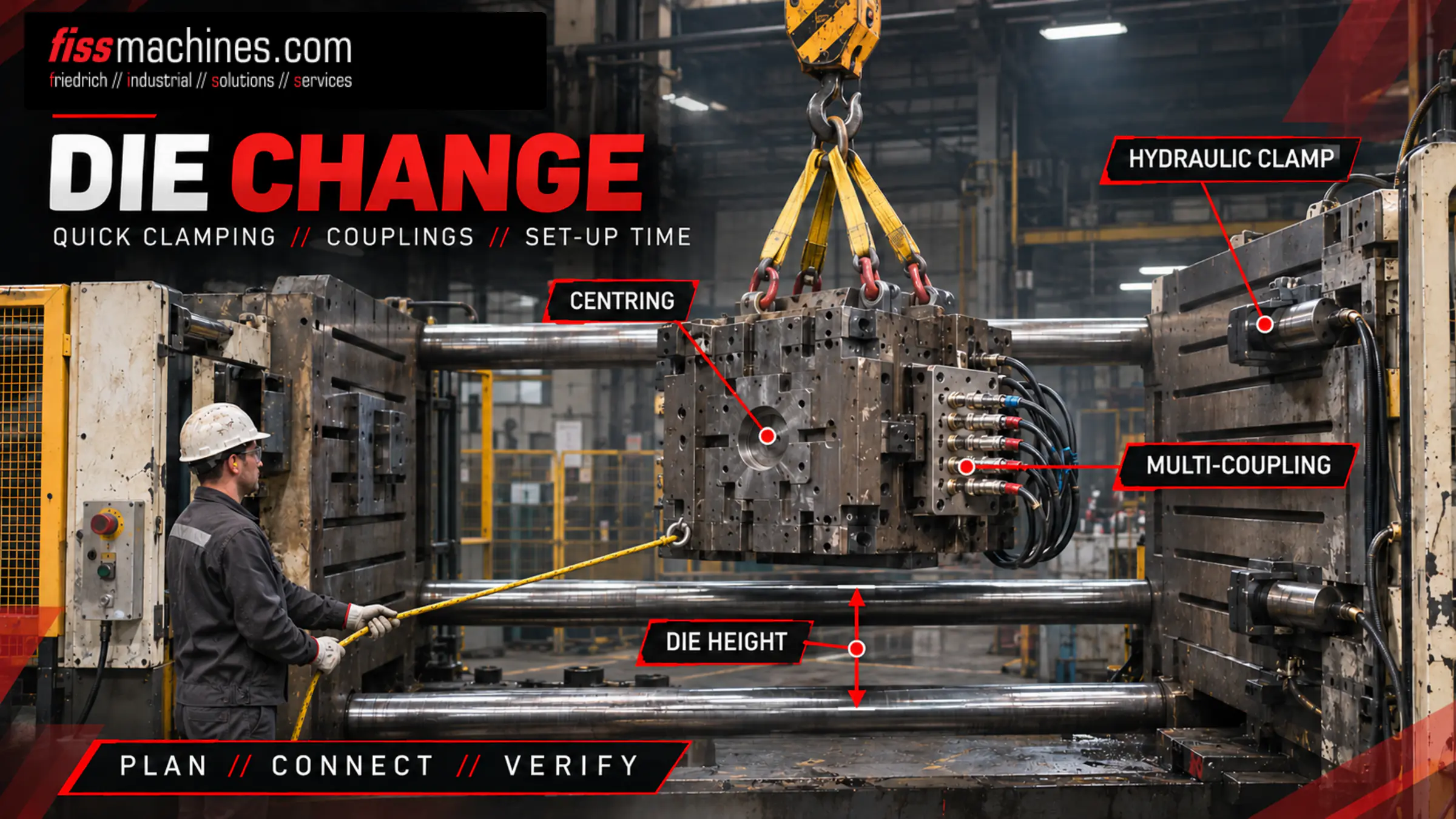
Die Change in Die Casting: Quick Die Change, Clamping Systems and Set-up Time
Every die change stops a die casting cell: the hot die comes out, the next goes in, is connected, heated and run in. How long that takes depends less on the machine than on preparation, standardised interfaces and clamping and coupling equipment.
What Is a Die Change in Die Casting?
A die change in die casting is the change-over of a die casting machine from one die to another: unclamping and removing the running die, installing, aligning, clamping and connecting the next die, bringing it to temperature and releasing production after the first good shots.
The set-up time runs from the last good part of the old die to the first good part of the new one. Quick die change reduces it through method (SMED) and equipment.
SMED in Die Casting: Internal and External Set-up
Shigeo Shingo’s SMED method (Single-Minute Exchange of Die, 1985) splits set-up work into internal tasks, possible only with the machine stopped, and external tasks, done while the previous die is still producing. The sequence: record the current change-over, separate internal from external work, convert internal into external work, streamline the rest.
| Activity | Often internal today | How it becomes external or shorter |
|---|---|---|
| Providing die, shot end parts, bolts, tools | Searching during the stop | Complete kit at the cell before the stop |
| Die preheating | Heating on the machine | Offline preheating before the change |
| Robot, sprayer and extractor programmes | Programming after installation | Prepared and stored per die |
| Clamping | Individual clamps and bolts | Standardised clamping edges, central actuation |
| Water, oil and hydraulic connections | Single hoses, risk of mix-ups | Multi-couplings, coded hose sizes |
A published example from magnesium high-pressure die casting: at a UK plant, changeovers were cut from 24 hours to an average of 6½ hours over 18 months (Pendry, 2018). The gains came from palletised shot end parts, a crane reserved for the change, prepared kits and standardised clamping and hoses – not from a faster machine.
Which Steps Does a Die Change on a Die Casting Machine Involve?
The exact sequence follows the operating manuals; a typical order on a horizontal cold-chamber machine:
Prepare Externally
Next die checked and preheated, shot end parts, clamps, hoses and lifting gear ready.
Stop and Make Safe
Last shot, temperature control to cooling or draining as specified, hydraulics depressurised, machine secured against restart.
Disconnect
Temperature control circuits, jet cooling, hydraulic core cylinders, vacuum and sensors disconnected; ejector coupling released.
Remove the Die
Die halves secured together, unclamped and lifted out by crane or moved out on a die cart or roller table.
Install and Set
New die centred, die height adjusted, die clamped, media and ejector connected, movements checked at reduced speed.
Start Up
Die brought to temperature, warm-up shots, first-part inspection and release.
Crane or die cart? A crane is flexible but becomes the bottleneck if it is busy elsewhere. Die carts and roller tables let the preheated die wait beside the machine, but need space and dies built for rolling in. Which die components are disconnected is described in Die Casting Dies: Die Halves, Ejectors and Slides.
Mechanical, Hydraulic or Magnetic Die Clamping?
The die clamping system holds both die halves on the platens against opening, ejection and core forces and the die weight. Three principles are used:
| Criterion | Mechanical (clamps, bolts) | Hydraulic clamping | Magnetic clamping |
|---|---|---|---|
| Set-up effort | High, each clamp tightened by hand | Low with central actuation | Low, switched centrally |
| Die requirements | Clamping slots or bores | Clamping edge matching the clamps | Flat steel back plate |
| Temperature | Uncritical | Limited by seals and sensors | Limited by the magnetic plate |
| Monitoring | Visual only | Pressure and position monitoring possible | Sensor-monitored clamping cycle (manufacturer) |
| Typical limitation | Time, forgotten bolts | Hydraulic supply, heat at the platen | Platen temperature, die weight and ejection forces |
Manufacturer statements show the limits. Roemheld specifies hydraulic arch clamps for die casting machines up to 250 °C, standard position monitoring up to 100 °C and a mechanical lock that holds the die if pressure is lost (trade report, 2024). For magnetic clamping on zinc hot-chamber machines, Roemheld reports dies at about 180 °C and savings of up to 40 minutes per change versus clamping claws, but does not use it for aluminium and magnesium (process temperatures around 650 °C).
Multi-Couplings for Water, Oil and Hydraulic Cores
A die casting die can carry many temperature control, jet cooling and core circuits. Connecting them one by one takes time, and a swapped or forgotten circuit only shows up as a hot spot or defect. Multi-couplings group the circuits on one plate. Stäubli states that its UCP multi-coupling for jet cooling connects all circuits “in a single action and at a single location”, with temperature limits of +15 to +80 °C or −10 to +150 °C depending on the connector (manufacturer brochure).
Couplings and hoses must be rated for the medium – water, thermal oil or hydraulic fluid. Without multi-couplings, coded hose sizes help: the plant described by Pendry gave inlets and outlets different diameters so they cannot be swapped.
Offline Die Preheating and the First Shots
Die preheating on the machine is usually the longest internal step. Preheating offline – on a preheating station or with a separate temperature control unit – turns it into external work. In the magnesium plant mentioned above, dies at ambient temperature needed around 8 hours to heat up and were heated for at least 24 hours before the change; heating too quickly or too much caused expansion so that the die could not be closed (Pendry, 2018).
Preheating temperatures and heating rates come from the steel supplier and the die maker; the background is explained in Die Life in Die Casting. FISS lists used temperature control units, also usable for offline preheating. Pendry notes that much scrap arises at the start of a run after a change.
Die Change Checklist: From Preparation to First-Shot Approval
- Die, shot end parts, clamps and hoses checked and at the cell before the stop
- Lifting gear, crane or die cart reserved; load ratings match the die weight
- Die preheated to the specified temperature; programmes for robot and sprayer loaded
- Hydraulics depressurised and machine secured before anyone works between the platens
- Centring checked, die height adjusted, all clamps confirmed by the monitoring system
- Every circuit checked for flow and leaks; ejectors and cores tested at low speed
- First-shot approval documented: dimensions, visual inspection, process data against the reference
Quick Die Change on a Used Die Casting Machine: What to Check
Whether dies and clamping equipment fit a used die casting machine is decided at the platens, not by the clamping force class:
T-Slots, Bores and Centring
Slot and bore pattern, centring diameter, flatness and damage on both platens against die drawings and clamps.
Die Height Range
Minimum and maximum die height, tie bar spacing and opening stroke for the thinnest and thickest die; adjustment tested over its full range.
Clamping and Media
Existing quick clamping system, ejector coupling, core-pull circuits and coupling types; plan missing items as retrofit.
How die height adjustment differs between toggle and two-platen machines is explained in Toggle or Two-Platen Machine?; the complete inspection is covered in Buying a Used Die Casting Machine: The Technical Checklist. Set-up time counts directly in availability and OEE, see Die Casting Cycle Time.
Shorter Die Changes Start Before the Machine Stops
A die change in die casting becomes shorter mainly through method: everything possible while the old die is still running is moved outside the stop. Quick clamping, multi-couplings and offline preheating then shorten the internal steps – provided dies and machine share standardised interfaces and first-shot approval is clearly defined.
Questions About Die Change in Die Casting
What Is the Difference Between Internal and External Set-up?
Internal set-up can only be done with the machine stopped, such as unclamping the die. External set-up is done while the previous die is still producing, such as preheating the next die. SMED moves as much work as possible to external set-up.
Is Magnetic Die Clamping Suitable for Aluminium Die Casting?
Roemheld describes magnetic clamping for zinc hot-chamber machines with moderate die temperatures and does not use it for aluminium and magnesium because of the higher temperatures. For aluminium, mechanical and hydraulic clamping are the common solutions.
Why Preheat a Die Offline?
Preheating on the machine is often the longest internal step of a die change. A die preheated offline reaches operating temperature sooner and shortens the stop.
Does a Quick Die Change System Fit Every Die?
Only if the dies have matching clamping edges, centring and coupling plates. Older dies often need adaptation, so standardisation is usually introduced step by step.
Find a Die Casting Machine That Fits Your Dies.
FISS lists used cold-chamber and hot-chamber die casting machines and peripheral equipment. Send us your die dimensions and we check which machines fit.
Sources
A. Pendry (Birmingham City University): Magnesium Alloy Die Casting Process Improvement using the Single Minute Exchange of Dies (SMED) Method and Other Techniques, Mg2018 conference paper, open access, accessed 19 November 2026.
S. Shingo: A Revolution in Manufacturing: The SMED System, Productivity Press, 1985 (cited via Pendry 2018 and Wikipedia).
Wikipedia: Single-minute exchange of die, accessed 19 November 2026.
Römheld GmbH Friedrichshütte: Special requirements for die casting, application report, wz.roemheld.de; product page R-MAG-D magnetic clamping system for die casting machines, accessed 19 November 2026.
Machinery Market: Clamps for high-temperature applications (Roemheld UK), 1 November 2024, accessed 19 November 2026.
Stäubli: UCP multi-couplings – Temperature control | Die casting jet cooling, brochure, accessed 19 November 2026.
