




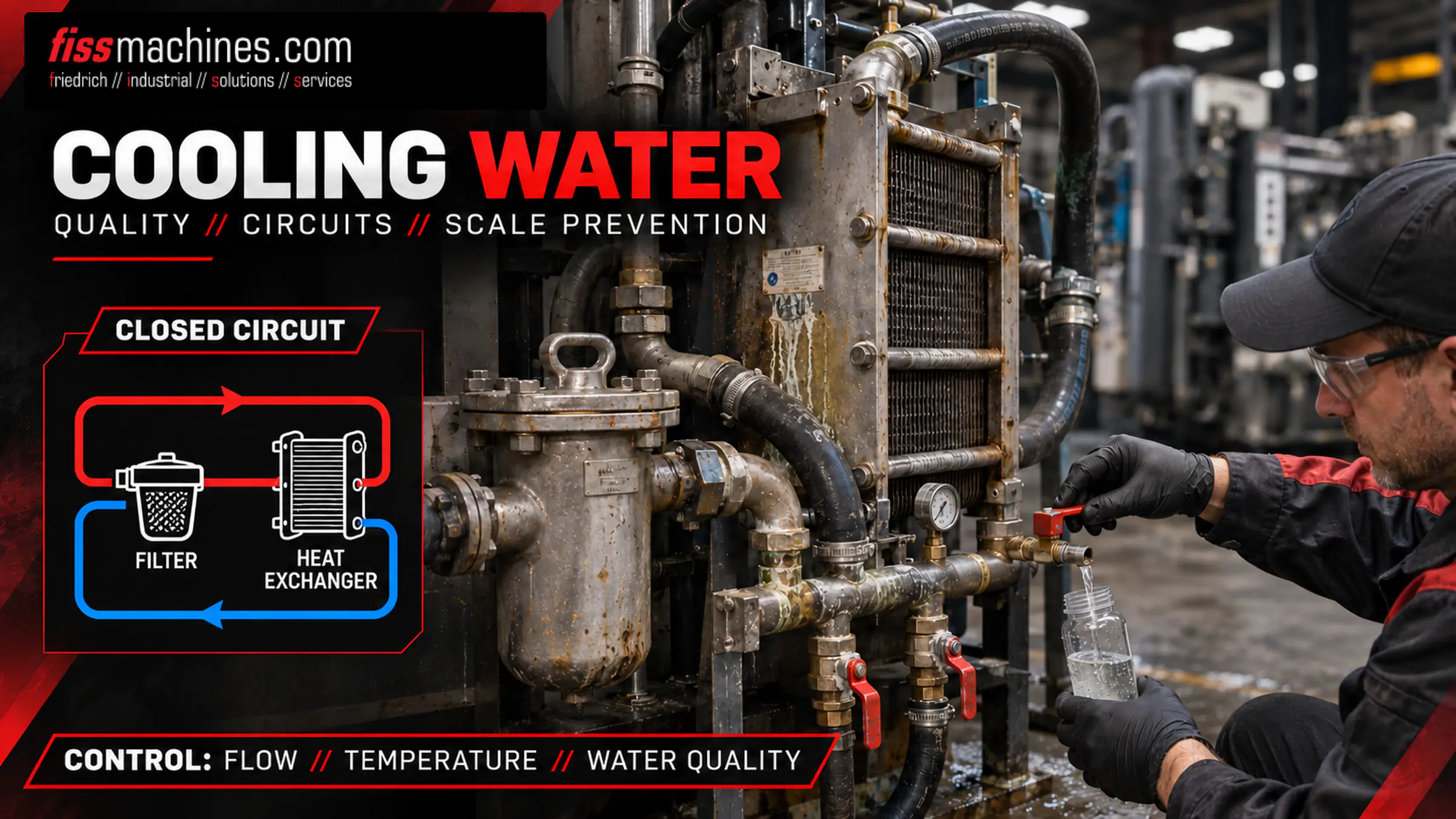
Cooling Water in Die Casting: Water Quality, Circuits and Scale Prevention
Die, shot end, hydraulic unit and often the furnaces pass their heat to the plant cooling water. When that water carries scale, sludge or bacteria, cooling capacity drops long before an alarm appears.
What Is Die Casting Cooling Water?
Die casting cooling water is the plant-side water supply that removes process heat from a die casting cell: from die circuits and temperature control units, shot sleeve and plunger cooling, hydraulic oil coolers and, where present, induction furnace coils. The heat is finally rejected through a cooling tower, a dry cooler or a chiller.
Reliability depends on the circuit layout, water quality matched to the most sensitive consumer, and consistent treatment and hygiene.
Which Consumers in a Die Casting Cell Need Cooling Water?
Consumers differ in temperature level, flow demand and sensitivity to dirt. The overview is typical; required values come from the machine and equipment documentation.
| Consumer | Task | Particular Sensitivity |
|---|---|---|
| Die circuits and temperature control units | Remove casting heat, keep the die in its window | Small channels and spot cooling clog first |
| Shot sleeve and plunger tip | Limit temperature and wear at the shot end | Narrow bores, high local heat flux |
| Hydraulic oil cooler | Keep the hydraulic fluid within its approved range | Fouled heat exchanger raises oil temperature |
| Induction furnace coils | Cool coil, converter and cables | Dissolved minerals, especially iron; leaks near melt |
How temperature control units heat and cool the die is explained in Temperature Control in Die Casting; this article covers the water behind them. The hydraulic side is covered in Hydraulics of Die Casting Machines.
Ambrell recommends a separate closed clean-water loop for induction equipment, because the coil field can make dissolved iron and minerals precipitate (manufacturer statement). Furnace cooling follows the furnace manufacturer’s specification; risks are discussed in Induction Furnace or Crucible Furnace?
Open or Closed Cooling Circuit: Which Recooling Concept Fits?
In an open circuit, the water itself is cooled by evaporation in a cooling tower and is in contact with the air. In a closed cooling circuit, the process water stays in pipes and heat exchangers; it is recooled indirectly. Many foundries combine both: a closed secondary circuit to the machines, separated from the tower by a plate heat exchanger.
| Recooling Concept | Principle | Water Contact With Air | Treatment Effort |
|---|---|---|---|
| Open cooling tower | Evaporation of part of the circulating water | Yes | High: salts concentrate, dust and microorganisms enter |
| Closed-circuit cooling tower | Process water in a coil, spray water evaporates outside | Spray water only | High on the spray side, low inside the coil |
| Dry cooler | Air-cooled heat exchanger, no evaporation | No | Low; supply temperature depends on ambient air |
| Chiller | Refrigeration circuit | No (process side) | Low; highest energy demand per kW of heat removed |
Why separation matters: BAC’s application guidelines allow circulating tower water up to 2,400–4,000 µS/cm conductivity, depending on the material of the unit. HB-Therm’s guide value for water in its temperature control units up to 110 °C is below 150 mS/m, i.e. 1,500 µS/cm (both manufacturer statements). Tower water fed directly into dies can exceed what temperature control units tolerate.
Which Cooling Water Quality Values Matter?
There is no universal limit for cooling water quality. As an example, HB-Therm publishes these guide values for its Thermo-6 temperature control units (manufacturer statement); untreated water within them can generally be used without treatment.
| Parameter | Guide Value (HB-Therm) | Why It Matters |
|---|---|---|
| pH | 7.5–9 | Low pH promotes corrosion |
| Conductivity | < 150 mS/m (≤ 110 °C), < 50 mS/m (110–180 °C), < 3 mS/m (> 180 °C) | Measure of dissolved salts, corrosion tendency |
| Total and carbonate hardness | < 2.7 mol/m³ (< 15 °dH) up to 140 °C; < 0.02 mol/m³ above 140 °C | Hardness forms scale on hot walls |
| Chloride | < 50 mg/l (≤ 110 °C), < 30 mg/l (110–180 °C), < 5 mg/l (> 180 °C) | Pitting and stress corrosion |
| Sulfate, ammonium | < 150 mg/l, < 1 mg/l | Attack on materials |
| Iron, manganese | < 0.2 mg/l, < 0.1 mg/l | Deposits and sludge |
| Particle size | < 200 µm | Blocks valves, nozzles and small channels |
According to HB-Therm, the high-temperature values usually require softening or demineralisation, and make-up water must be of drinking water quality. Other manufacturers publish different values – the unit’s manual applies.
Scale, Corrosion and Biofilm: How Cooling Channels Lose Capacity
Deposits insulate the channel wall and narrow the cross-section. Scale in cooling channels therefore reduces heat transfer and flow together – the die runs hotter exactly where cooling matters most.
Hardness Precipitates on Hot Walls
Carbonate hardness settles where water is heated – die channels, sleeve cooling, heat exchangers.
Salts, pH and Mixed Metals
Chloride and low pH attack metals. BAC discourages fully softened make-up water as corrosive and recommends a residual hardness.
Slime Below About 60 °C
HB-Therm asks for germ count monitoring below 60 °C and a biocide above 1,000 CFU/ml. BAC notes that slime can favour legionella.
Thermal consequences in the die, such as heat checking and soldering, are covered in Die Life in Die Casting.
Cooling Water Treatment: Blowdown, Filtration and Dosing
In an evaporative tower, dissolved solids stay behind. BAC defines the cycles of concentration N as the ratio of dissolved solids in circulating to make-up water; the most restrictive parameter sets N. The bleed (blowdown) rate follows as B = E / (N − 1), with the evaporation rate E ≈ flow rate (l/s) · cooling range (K) · 0.0018.
Illustrative example: a tower circuit with 10 l/s and a cooling range of 10 K evaporates about 0.18 l/s (BAC example). At N = 3, the bleed is 0.18 / 2 = 0.09 l/s, roughly 0.3 m³/h – on top of the evaporated water. The method sizes blowdown, not annual consumption.
- Analyse make-up and circulating water
- Install strainers or side-stream filters; HB-Therm’s particle limit is 200 µm
- Dose chemicals automatically, not in batches into the tower basin (BAC)
- Check inhibitors and biocides for material compatibility
- Monthly monitoring by a competent water treatment company (BAC)
Cooling Tower Legionella: What the German 42nd BImSchV Covers
In Germany, evaporative cooling systems, cooling towers and wet scrubbers are covered by the 42nd BImSchV (ordinance of 12 July 2017, in force since 19 August 2017; no amendment noted in the official consolidated text). Systems must be designed and operated so that contamination with microorganisms, in particular legionella, is avoided according to the state of the art. In the ordinance’s terms, a typical fan-driven foundry cooling tower is an evaporative cooling system; “cooling tower” there means large natural-draught towers above 200 MW.
Obligations include a risk assessment before commissioning, at least two-weekly internal checks, legionella lab tests at least every three months, an operating logbook, notification to the authority within one month of first filling and an expert inspection every five years. Annex 1 sets test values of 100 and 1,000 and an action value of 10,000 CFU legionella per 100 ml. Excluded are, among others, closed circuits that transfer heat directly to air, such as dry coolers, and systems installed in a hall that emit only into it.
Planning Cooling Water for a Used Die Casting Machine
Deposits from the previous site, missing strainers or unknown hose sizes often only show up at start-up. This sequence helps plan the connection.
List Consumers and Heat Loads
Die circuits, temperature control units, shot end, oil cooler, furnaces – from documentation and nameplates.
Define Flow, Pressure and Temperature
Required flow rate, supply pressure, differential pressure and supply temperature per consumer.
Check Connections and Filters
Thread sizes, quick couplings, hose diameters, strainers upstream of sensitive consumers.
Clean Before Start-Up
Flush circuits, descale heat exchangers and temperature control units, replace aged hoses.
Analyse Local Water
Compare site water with the guide values of every unit; plan treatment or separation.
Media connections at the new site are part of the planning in Relocating a Die Casting Machine; recurring checks are listed in Preventive Maintenance of Die Casting Machines.
Cooling Water Is Part of the Process
Die casting cooling water determines how much heat dies, shot end and hydraulics can release. A closed secondary circuit, water quality based on the most sensitive consumer, filtration, controlled blowdown and documented hygiene keep cooling capacity stable.
Questions About Die Casting Cooling Water
Can Tap Water Be Used in Temperature Control Units?
Often yes, if it meets the unit manufacturer’s guide values. HB-Therm, for example, requires drinking water quality. For higher temperatures, softening or demineralisation is usually needed.
Why Should Cooling Tower Water Not Go Directly Into the Die?
Open tower water concentrates salts and picks up dust and microorganisms. A plate heat exchanger separates the tower from a clean closed circuit to the machines.
Does a Dry Cooler Fall Under the 42nd BImSchV?
Heat exchangers that keep the fluid in a closed circuit and transfer heat directly to air are excluded from the ordinance. Systems that spray water are a different case and should be clarified with the competent authority.
How Often Should Cooling Water Be Checked?
BAC recommends monthly monitoring for evaporative units; in Germany, the 42nd BImSchV sets its own intervals for evaporative cooling systems.
Used Temperature Control Units From FISS.
FISS lists used water and thermal-oil temperature control units for die casting. Contact us when planning a used machine.
Sources
Verordnung über Verdunstungskühlanlagen, Kühltürme und Nassabscheider (42. BImSchV) of 12 July 2017, BGBl. I p. 2379, gesetze-im-internet.de, accessed 19 November 2026.
HB-Therm: Betriebsstoffe – Wärmeträger Wasser, Thermo-6 knowledge base, version 2534, accessed 19 November 2026.
Baltimore Aircoil Company: Chapter 19: Application Guidelines (water quality, blowdown, biological control), EDv11, accessed 19 November 2026.
Ambrell: Water Cooling Systems, product page, accessed 19 November 2026.
